


The Internet Before Platforms
I built my first website in 1997. I was 13 going on 14. It was a fan site for a TV show. I’m not telling you which one; we just met! It had episode guides, fan art galleries, and show reviews.
This was back when we had just discovered chat rooms. I was part of a community that got online regularly to share our art with each other and talk. There wasn’t a platform taking a cut of our time and selling it back to us as a product. Way before the algorithm decided what you’d see next. Before any of that existed, we were just finding each other, building things together, and surfing on Netscape.
Does anyone else remember that? Ah, also, that America Online dial-up sound. That ICQ “uh-oh!” Once I saw how the internet connected people, I was hooked. Once I figured out how to build on it, I couldn’t stop. That’s how it started.
By the time I was in high school, I was learning how to code websites for different things. I built one for my project for the Science & Engineering fair my senior year, and it picked up some awards. Learning and designing websites from scratch became something I really enjoyed.
By the time I got to college, the internet had become a real thing for ordinary people. I was studying psychology and art history. Nobody steered me toward computer science, which in hindsight kinda feels like a big oversight. I didn’t connect the dots myself; I was an artist and I was fascinated by how the brain worked, so that’s the direction I went. I continued learning other programming languages using resources I found online, and then, shortly after, WordPress started taking off and more and more people wanted a website.
Somewhere in that mix of understanding people, loving visual things, and knowing how the web worked, I figured out I had a skill that most people didn’t at the time. That turned into my first job at a travel tech startup, which then turned into years of learning about Software as a Service and from the latest developments in UI/UX design to drive engagement and sales.
From there, I kept going: deep into political tech, nonprofits, advocacy organizations, and campaigns. I worked for tech startups, small businesses, elected officials and candidates, government organizations, celebrities…and even at some places in the jungle!
I’ve worn a lot of hats, from digital strategy to hands-on execution — but the common thread has always been serving as a translator between people and code. I’ve had the opportunity to build tools that raised millions for causes I care about and help organize actions across the country, with results that still make me proud. The internet has always felt exciting to me. A place where connection creates possibility, and where the right idea, shared at the right moment, can bring people together to make real change.
I’m sharing all of this because I want you to understand that I am not afraid of emerging technology.
Each Wave Took Something
I think the first time I felt a shift was when Wix showed up. Besides custom websites and apps, platforms like WordPress had always kept developers like me in the loop, since someone still had to set up the infrastructure, maintenance, and do the custom work.
Wix was different. Suddenly, clients who would have called me were just… doing it themselves. And I get it, I genuinely do. A small business owner who just needs a simple site shouldn’t have to hire someone like me. Wix was fine for what it was. The market had spoken. I adapted. Some of their websites were objectively terrible, and inevitably fixing bad decisions was also in demand!
Then came Squarespace, Fiverr, Webflow, Canva, and a hundred other tools that commoditized the execution layer of what I had previously done in one way or another. Each wave took something. Each time, I moved up the stack. More big-picture strategy and management, less production.
Then Jasper AI (formerly Jarvis) came out around 2021. It was similar to most writing AI chatbots you see today, but used more structured templates, was more expensive, and was better trained in persuasive writing and marketing styles. When I saw what it could do, I knew where things were headed. The price point kept it contained to a few, mostly digital marketers.
But when ChatGPT’s freemium model launched and AI adoption finally arrived in the rest of the world and all the apps, it did something different. It came for all of the layers at once: Advising strategy, fixing website errors, designing landing pages, building apps, writing copy, creating graphics, producing video, and… everything.
The entire freelance economy I’d been in over decades was compressed, disrupted, and repriced faster than any previous wave. It’s not quite there yet; you still need to know what you're doing to get the right results. But it’s getting close. Now we’re entering the era of agentic AI systems set up to act autonomously and can do just about anything with “AI agents,” and recursive AI that can improve itself without any human intervention.
I’m not writing this to complain about it; I’ve been very fortunate and still get to work on incredible projects I believe in. But each of those waves happened on its own timeline. Wix, Squarespace, and other SaaS apps were chipping away through the 2010s, but now AI has hit everything within the last few years.
Unfortunately, the discourse I see on social media platforms like Facebook is mostly shaming small business owners and people trying to make ends meet for using AI tools. No nuance. No bigger picture.
On Facebook
Let me share with you what Facebook actually is: Facebook is owned by Meta, a company whose data centers have been consuming billions of gallons of water per year in drought-stressed communities, allowed with the same impunity as any other extractive industry.
Meta built its first dedicated hyperscale data center in Oregon back in 2011. These are the data centers that are in the news now, designed for massive cloud computing and AI workloads.
Meta’s AI infrastructure is already a threat today. It is running right now, at an enormous scale, on data that users gave them for free: your posts, your photos, your reactions, your behavior, everything you’ve ever clicked on, lingered over, or typed and deleted over the years.
Every time you open the app, you're inside one of the most sophisticated AI and machine learning systems ever built. The feed you’re scrolling? AI. The ads that know things about you that feel a little too accurate? AI. The facial recognition that tagged your photos for years without your opt-in? AI. Facebook didn’t just become AI. It has been AI for a long time. You just stopped noticing because it became familiar. It became life.
When someone opens Facebook, scrolls past three algorithmically-selected posts, clicks on an AI-curated ad, and then shares an article about how people using AI are ruining everything… I genuinely don’t know what to do with that.
To me, it’s like when people point to the carbon footprint of air travel to shame individual flyers. And yes, a long-haul flight has a real footprint. That’s true. We aren’t all Taylor Swift, though, whose annual aviation emissions are estimated to be roughly as much as 1,800 times higher than the yearly carbon footprint of the average human.
At the end of the day, the decision to build a global economy around fossil fuels wasn’t made by the person booking a ticket to visit their family. It was made by governments, corporations, and decades of policy choices that left most people with no clean alternative. Institutional and large commercial customers, not retail consumers, opted the world in.
Shaming the retail consumer in this case is a very effective way of moving accountability away from the people who actually set the terms.
AI is the same. Telling a small business owner to stop using generative AI won’t stop AI. People across the world are using ChatGPT and similar artificial intelligence services, and American workers are now competing with them, too, as companies increasingly outsource for cheaper labor. The data centers keep running. The water keeps flowing. The energy keeps being consumed. Amazon, Meta, Google, and Microsoft keep building regardless. Their largest customers are not you, the consumer.
I believe in boycotting wherever you can. Don’t give these companies your money or your data if you don’t want to. That’s a coherent choice with real impact. Get off ChatGPT. Cancel Prime. Don’t use Spotify. Use alternatives.
And here’s something else that nobody in these conversations ever seems to mention: some of us run AI models locally on our own computers. They require no cloud and no data center. That option exists. It’s worth knowing about. I don’t believe AI is inherently evil. It’s a tool that can do a lot more than make pictures.
But shaming a freelancer for using an AI tool to stay competitive isn’t a boycott. It doesn’t touch Meta’s bottom line at all. The planes fly whether you’re on them or not (unless there is a fuel crisis).
The Artists Are Not Wrong
I see the artists, musicians, video editors and the writers who are furious. I understand it; I’m one of them. Watching something you’ve spent years mastering get automated is not a small thing. That anger is real, and it’s valid — I was using the em dash before AI ruined it.
I do have to say here that I find it deeply ironic, for example, when a musician complains about apps like Suno and AI generated music in general having no soul, while using AI generated art or video for their album covers or reels on Instagram. Even within the artist community, folks pick and choose what is deemed ok.
There’s intellectual property theft happening with all of these tools, and it’s what I think infuriates most people. Many artists never consented to having their work scraped to train the models that now compete with them. That deserves its own conversation. But even there, the target should be the companies that built the models on stolen work, not the person using the tool.
And solutions exist for that, too: mandatory licensing, opt-out registries, revenue sharing, and supporting companies that build clean licensed datasets from the start. The copyright lawsuits are already working through it. We should keep pushing.
But there’s a difference between a valid grievance and a well-aimed one. We should be punching up, not down.
Who’s really to blame?
I’ve never liked gatekeepers. One of the things I loved most about the early internet was that it was genuinely open. If you could figure it out, you could participate regardless of background.
AI tools are the most democratizing technology since the browser. They’re giving people access to capabilities that used to cost thousands of dollars in professional fees. A first-generation entrepreneur, a single parent running a small business, an upstart candidate, a creator who can’t afford a full production team; these are the people being shamed on Facebook for using them.
Meanwhile, Meta runs one of the largest AI systems on the planet on your data every day.
I’ve read comments like, “Well, if you can’t afford to hire a designer, you shouldn’t have a business...” Then I check their website, and of course it’s built on Wix or using Canva decks, or any number of other website building tools that have integrated generative AI into their product and use the same hyperscale data centers.
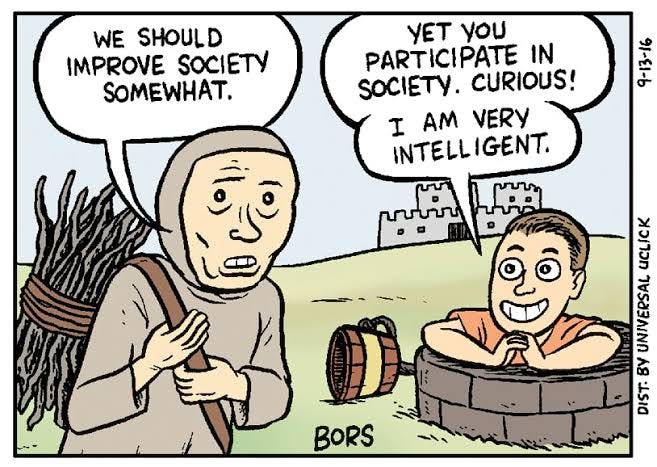
Whenever this double standard is brought up, the “We Should Improve Society Somewhat” meme enters the chat, somehow excusing their own contributions to the Meta machine and other similar apps as more necessary than someone trying to market their salon.
The cognitive dissonance is not subtle.
When someone shares an AI-generated thing and gets called dystopian for it, remember that they didn’t build the infrastructure. They didn’t lobby against regulation. They are just trying to make or share something, and most of the time, they don’t understand the underlying technology. Educate.
The people who decided this technology would be deployed at scale, without guardrails, and into every corner of the economy, are not in that comment thread on the app that is consuming all that water and using generative AI. They’re in Washington and on earnings calls.
Direct the energy there, please.
If we can’t move past the “AI = Good vs AI = Bad” conversation, we will not react in time to stop the growing list of threats from this technology.
Those Building It
My question is, what exactly is driving this unfettered demand for growth? It’s not the freelancer using AI to write a caption, nor is it the small business owner who can finally afford to compete because these tools exist.
Is this really about consumer AI? It seems to me that we are seeing a convergence of powerful special interests looking to exploit the technology to advance their own goals, in many cases without thinking or caring about the consequences.
In the United States, it’s Meta. It’s Amazon. It’s Microsoft. It’s Google. The same companies that have been consolidating the internet for two decades, the same ones whose infrastructure dwarfs anything an individual user touches.
Our government is pushing it, and so are the governments in Europe, China, India, and Canada. There are currently data centers in 179 countries, and demand is predicted to nearly triple by 2030.
They are all taking different approaches. In China, for example, their court ruled that a worker can’t be replaced by AI. In Europe, they passed the EU Artificial Intelligence Act, which is a step in the right direction, but still leaves certain applications unregulated.
In the United States, however, AI development continues mostly without any comprehensive federal oversight. Alarmingly, we continue to hear stories that further permit infringement of rights as they pertain to AI. For example, judges in the U.S. Court of Appeals for the 7th Circuit recently ruled that the First Amendment protects the private possession of AI-generated CSAM when the images do not depict real children. The ruling raises some pretty disturbing questions about what happens when technology advances faster than the laws designed to regulate it.
This week, AI researcher Jacob Coxon publicly resigned from Anthropic to sound the alarm, writing “The people building AI earnestly believe that it could kill us all by the end of the decade,“ emphasizing that the next year or two are “crunch time” for humanity. He quit just before Anthropic’s planned IPO, walking away from arguably the biggest payday in the history of capitalism. He seems to really mean what he’s saying.
Coxon says that the people in these companies are very aware of the risks, but continue to push forward recklessly because they are locked in a race to be the first to achieve superintelligence, operating under a classic prisoner’s dilemma logic: if they don’t do it first, someone else will. Others can’t be trusted to do it safely and ethically, therefore only they can be trusted to do it… that’s what they say anyway.
And we see the goalposts continue to move. First it was AGI. Now it’s superintelligence. All with relatively little safety or accountability for the models that exist now. What happens when we get there?
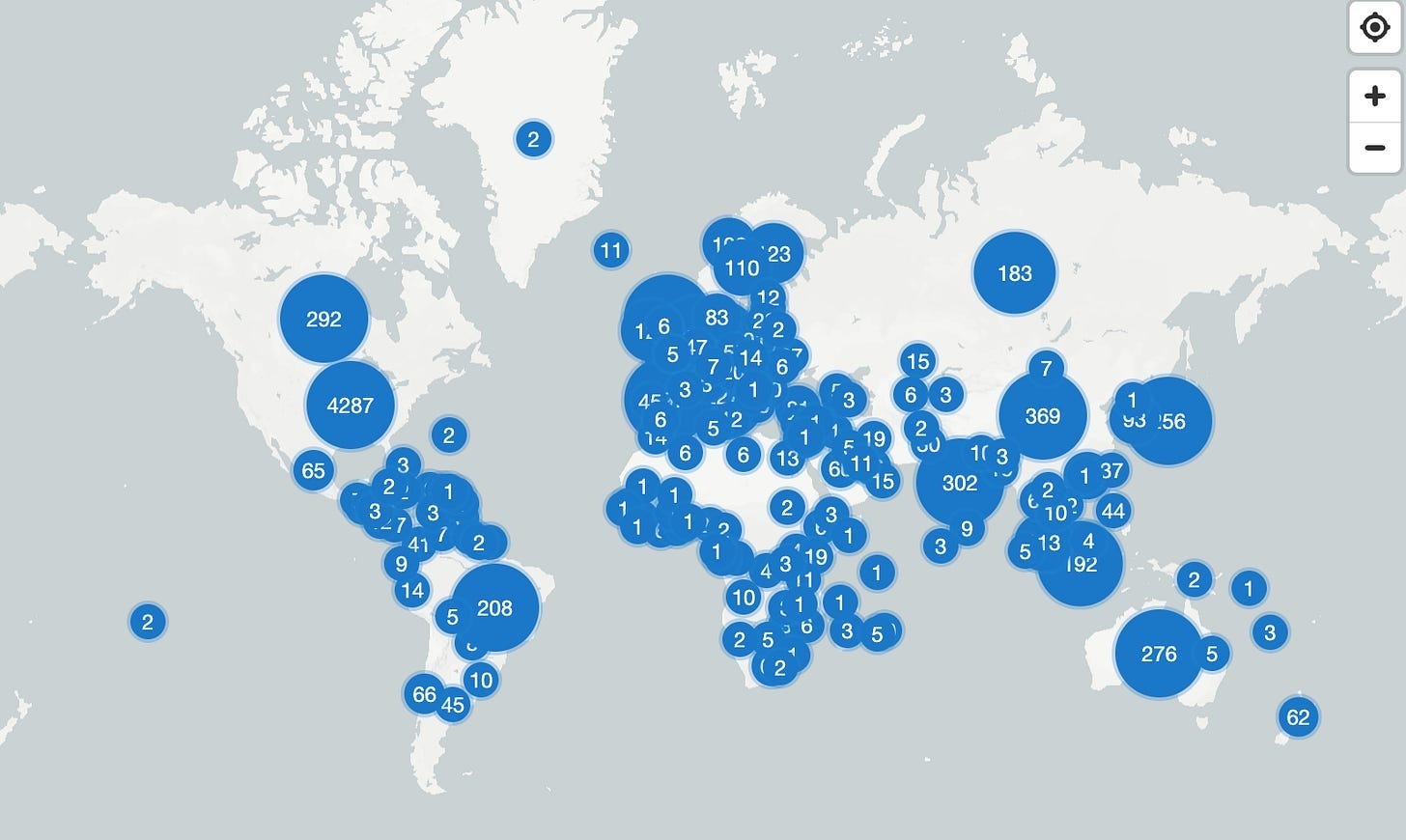
Map of Worldwide Data Centers (Source: datacentermap.com)
Data Centers and the Infrastructure Race
Someone using Claude to survive in a market that AI has already disrupted didn’t decide to deregulate the AI industry, nor did the small business owner using generative tools negotiate the “ratepayer protection pledge” that Trump announced at this year’s State of the Union address. A pledge that essentially handed Amazon, Google, Meta, Microsoft, and friends the green light to build their own private power infrastructure, outside normal utility oversight, with minimal regulation.
Amazon, Microsoft, and Google alone already control 58% of the world’s hyperscale data centers, and hyperscalers are on track to hold two-thirds of all global data center capacity by 2031.
The current administration’s response to this has not been regulation. It has been a dangerous escalation. I don’t believe that a single surveillance center — I mean data center — should be built without answering serious questions about environmental impact, ownership, militarization, and purpose. Moratoriums all around.
Sanders and AOC have introduced a federal version of this in Congress, the AI Data Center Moratorium Act, but it’s sitting in committee, which is exactly where things go to die when no one is applying pressure.
This is not a fringe position. A Gallup poll from May 2026 found that 70% of Americans oppose data centers in their area. Nearly half of them believe it strongly. In the first three months of this year alone, local opposition blocked 75 projects worth roughly $130 billion. Reno has passed a moratorium. New York has paused approvals entirely.
Seventy percent of us don’t want these in our backyards. Imagine what that majority could do if we organized.
If that sounds alarmist, consider that the Pentagon is already integrating generative AI into classified military systems, according to recent reporting from the Associated Press. When a US tomahawk missile killed over 156 people in Iran, including 120 little girls, there was speculation that artificial intelligence was used in targeting, and organizations like Amnesty International have called for accountability after conducting an investigation.
Additionally, Palantir’s surveillance and predictive technology, which uses hyperscale data centers from Amazon, Microsoft, and Google, needs more computing power for the multibillion-dollar contracts they currently have with the government. A few days ago it was also revealed that Anthropic is also building predictive surveillance tech to monitor “anti-AI” activists.
Predictive, as in “pre-crime,” as in punishing someone before any crime is committed… like in the movie Minority Report. This should concern us all.
On May 1 of this year, Palantir received another contract to spy on federal workers with its technology. This is the same company that recently published a techno-fascist manifesto advocating for things like mandatory military service for U.S. citizens and a surveillance police state, which some said sounded like the “ramblings of a supervillain.”
If you don’t know what FLOCK cameras are, I suggest you look them up. They likely already looked you up.
What Was Built After 9/11
This isn’t new. The architecture for collecting and storing data on American citizens was built out in the open, right after September 11, with the Patriot Act and the creation of the Department of Homeland Security. We were told it was about terrorism. What was built was something much broader.
In 2013, NSA whistleblower Edward Snowden exposed the depth and breadth of U.S. surveillance programs. By the time I was at Standing Rock in late 2016, and saw teams of people documenting protesters on video, I wasn’t surprised. I already knew what the data was for.
This is worth sitting with: the seven or so companies being handed increasing control over global digital infrastructure are the same companies with longstanding U.S. government contracts.
These same companies have spent years accumulating data on hundreds of millions of people and are now building the physical infrastructure, the power, compute, and storage — to run what?
It’s a question worth asking. Loudly. On whatever platform you have.
Water, Power, and Corruption
Data centers consume real water, produce real heat, and run on power grids that were never built to sustain this kind of demand. The people who built them have never had to answer for any of it.
To put a number on it: a single large data center can use up to five million gallons of water a day. And it is not an accident where they get built. At least two-thirds of data centers constructed since 2022 sit in places where water resources are already stressed.
We have a long, well-documented history of allowing powerful infrastructure to be built and operated with minimal accountability, and then expressing shock when it harms people. AI is the latest iteration, but it could be the last.
And the people who should be most vocal about that structural problem: the consolidated ownership, the regulatory capture, and the externalized costs, are often the same people who instead post outrage content on a platform that is itself the product of exactly that dynamic.
I should say something here, because I can already hear the counterargument: easy for a tech person to say all this.
Let me be clear: I’m an environmentalist. I’ve spent the better part of a decade working for nonprofits, advocacy organizations, and progressive political campaigns. I joined the front line while an oil pipeline was being forced through sacred land and water. I’ve been tear-gassed, surveilled, and fired upon while engaging in prayerful non-violent action while exercising what are supposed to be my constitutionally-protected rights.
I know what an extractive industry backed by the state looks like. I know what it looks like when corporations get permission to violate civil rights, when the state punches down, when regulators look the other way, and when the damage gets externalized onto communities that had no say in the decision.
The unchecked growth of data centers is a real environmental issue. The water consumption is real. The energy demand is real. The obscene amount of heat they are producing is real. Their unchecked expansion needs to be stopped. I’m not dismissing any of it.
They have solutions to the environmental problems, and “zero impact” data centers are being built both here and by countries around the world already. There are entire companies in the US focused on improving the infrastructure to run them, look up Vertiv for example.
Dystopian billionaires like Peter Thiel are making investments to place floating data centers in the ocean to mitigate cooling costs and water consumption. They will put them in space if they have to. But they are building them, and don’t care what you think.
No Opting Out
You can’t really opt out of most of this, and that doesn’t get said enough. You can get off Facebook. You can cancel Prime. Those are real choices with real consequences for those companies.
But your bank is already running AI on your financial data. The government is already using it. Your city’s surveillance cameras are already feeding into systems that you never voted for and never consented to, because nobody asked you. By the time anyone was paying attention, it was already running and expanding into every aspect of your life.
Consumer choice here matters at the margins. People buying electric cars shifted the auto industry somewhat, but there is no electric car equivalent here. There is no clean AI alternative you can switch to that sits outside this infrastructure, unless you can afford to go completely off-grid. The choice was made for you, institutionally, long before the conversation about ethics caught up.
The Demand Doom Loop
Zack Exley, co-founder of Justice Democrats and founder of the New Consensus think tank, frames the stakes clearly in a recent Breaking Points segment. He argues that the technology itself cannot be stopped; the genie is already out of the bottle. Even if every data center went dark tomorrow, “within a few years you’ll be running powerful AI on your phone.”
The things preventing AI from already taking over any job that can be done on a computer, he says, “are mundane, they aren’t at the level of science or advanced software development,” and will likely be solved in the next couple of years if not sooner.
In my view, many of these companies are incentivized to go hard between now and the U.S. presidential election in 2028, because right now they have free rein. That means entire industries could become obsolete.
Soon.
“It’s like when the horse got automated out of a job,” Exley says.
It’s hard to wrap your mind around, and I think many are in denial because what it means is so overwhelming; I get that, too. However, I am most concerned about what happens to the U.S. economy when it arrives fully.
As of this writing, Meta has laid off 8,000 workers and has reassigned 7,000 more to train AI that will eventually replace them, too. More than half of U.S. spending is done by the top 20% of earners, and this is going to keep hitting those white-collar workers first.
When big companies replace workers with AI, those people will have less money to spend. Less spending means less demand. Less demand means more layoffs. More layoffs mean even less demand. It can bring a lot of suffering and poverty if we don’t intervene on a massive scale.
This demand doom loop is something Exley argues capitalism is not going to be able to sustain this time. “We haven’t experienced this with capitalism...a moment where capitalism runs out of customers.” It’s a conversation I think more people should be having.
It’s a big civilization-defining conversation with many possibilities. We are still in time to reclaim our Star Trek future without having to go through a painful collapse. The future where we develop this technology to improve life on earth for all beings instead of harming them is still possible, if only for a little while longer.
The good news, Exley says, is that, “we are still a part of the process of this stuff being built. We’re still a part of this technological explosion…and as long as we’re a part of it, maybe just for another few years, we can change course and we can turn it into something that really benefits us.”
Regulating AI should be what we are all focused on in this debate. Regulation both here in the US and internationally.
I don’t have all the answers. But I know what some of them look like, because they already exist: in the EU AI Act, in China’s worker protections, in the moratorium in Reno and the pause in New York… and in a federal bill sitting in committee waiting for enough people to make ignoring it more costly than passing it.
Congress isn’t going to lead on this. Neither is any president. They will need to be pressured, and our job is to make following us the only option they have left.
Because while we’re arguing about the wrong things, tech oligarchs and bad government actors are moving fast. They have the money, the data centers, and the contracts. We have the numbers.
Seventy percent of us don’t want this in our backyards. We are the majority. It’s time we acted like one. Talk to your people. Call your reps. Push your city council. Make sure this issue is front and center in the next election, and demand decisive action.